October 19, 2026
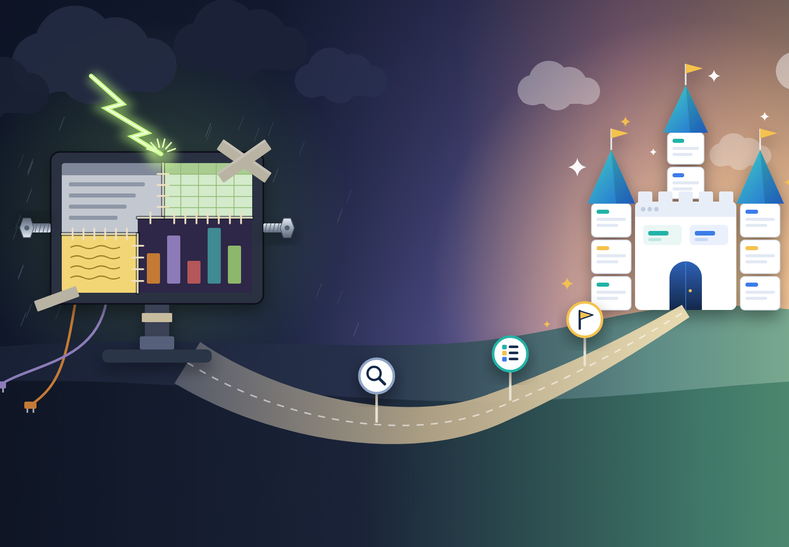
From Frankenstein to Fairytale: How to Take Your App From Stitched Together to a Scalable Product
Most apps don’t set out to become complicated. They start as a quick solution to a specific problem — a simple tool to track jobs, a basic dashboard, an internal system built fast because the business needed something, not everything. Then the business grows, and the app grows with it, one patch, one integration, one “quick fix” at a time.
That’s how a Frankenstein app gets built. Not through a single bad decision, but through years of reasonable ones, each added on top of the last, until the system holding your business together looks less like a product and more like something stitched from whatever was available at the time.
What Is a “Frankenstein App,” Exactly?
A Frankenstein app isn’t a failure. In most cases, it’s actually a sign of a business that’s been resourceful — solving problems as they came up, with whatever tools and time were available. The issue isn’t that the app exists. The issue is how it got built, piece by piece, over a long stretch of time.
It usually starts small: a tool built to solve one problem, maybe by a single developer or a small team working fast. Then another need comes up, and instead of expanding the original system in a planned way, a patch gets added. An integration gets bolted on to connect it to a new tool. A workaround gets built because fixing the root issue would take too long. A new feature gets squeezed in wherever it fits, not necessarily where it belongs.
None of those individual decisions are wrong in the moment. Each one solves a real problem, quickly, with the resources on hand. But stacked on top of each other, year after year, they turn into a system where the original structure is buried under layers of additions that were never designed to work together. The app still runs. It’s just held together by more duct tape than anyone can account for.
Signs Your App Is Becoming a Problem
A Frankenstein app doesn’t usually announce itself all at once. It shows up gradually, through a handful of symptoms that are easy to dismiss individually but add up to something harder to ignore over time.
A few of the clearest signs include:
- Bugs that show up frequently, often in places that seemed unrelated to whatever was just changed
- Performance that’s noticeably slower than it used to be, especially as more data or users get added
- Manual workarounds that employees have quietly built into their daily routines just to get around what the system won’t do on its own
- A reliance on one person — maybe the original developer, maybe whoever’s been around longest — who’s the only one who really understands how the pieces fit together
- Difficulty adding new features, where even small requests take far longer than they should
- Growing concerns about security or integrations, especially as more systems get connected to an app that wasn’t built with that many moving parts in mind
Any one of these on its own might not be alarming. A slow week, a tricky bug, a feature that took longer than expected — those happen. It’s when several of these signs show up consistently, and keep showing up, that they stop being isolated incidents and start being evidence of a system that’s reached its limits.
The Hidden Cost of Keeping It Patched Together
The real cost of a Frankenstein app rarely shows up as a single, obvious expense. It shows up as a slow accumulation of friction that’s easy to absorb month to month, but adds up to something significant over a year or more.
Maintenance is usually the first place that cost appears. Fixes that should take an hour take a day, because the person making the change has to carefully work around everything else the system depends on. That extra time doesn’t just cost money. It pulls attention away from building anything new, because so much of the available time goes toward keeping the existing system standing.
The second place that cost shows up is in how employees actually work. When a system can’t be fully trusted or doesn’t do what people need it to, employees build their own workarounds — a spreadsheet here, a manual process there — just to get their jobs done. Over time, the business ends up running on a mix of the official system and a web of informal fixes that live in people’s heads, which creates its own risk if any of those people leave.
The third place it shows up is with customers. Downtime, bugs, or slow performance don’t stay internal for long. A system that’s struggling under the weight of years of patches eventually affects the people relying on it from the outside, whether that’s a customer waiting on an order, a client trying to log in, or a user hitting an error at the worst possible moment.
And underneath all of that is the cost to growth itself. A system that’s difficult to change becomes a drag on every new idea. Expansion plans, new features, new integrations — all of them move slower, or get quietly shelved, because the technology underneath can’t keep pace with what the business wants to do next.
How to Turn It Into a Scalable Product
The good news is that fixing a Frankenstein app doesn’t usually mean starting over. In most cases, a complete rebuild is neither necessary nor the fastest path forward. What’s actually needed is a clear, honest look at what exists today, followed by a deliberate plan for what comes next.
That process starts with an audit — a real look at the existing application and the critical workflows that depend on it. What does the system actually do, and how well does it do it? Which parts are solid, well-built, and worth keeping exactly as they are? Which parts are fragile, outdated, or held together by workarounds that have outlived their usefulness?
From there, the path forward usually breaks down into three categories: what needs to stay, what needs to be rebuilt, and what can be consolidated. Some parts of the system might be working fine and simply need to be left alone. Others might be central to daily operations but built on outdated or unstable foundations, making them strong candidates for a rebuild. And some functionality might exist in three different places because of how the system grew over time, when it really only needs to exist in one.
Once that picture is clear, it becomes possible to build a roadmap — a sequence of improvements that moves the system toward something scalable, without requiring the business to pause operations or throw out everything that currently works. The goal isn’t a dramatic overhaul all at once. It’s a deliberate path from where the system is today to where it needs to be, taken in a way the business can actually absorb.
Knowing When It’s Time to Make the Move
Not every patched-together app needs to be rebuilt immediately, and not every sign of strain means it’s time for a complete overhaul. But there are a handful of indicators that tend to show up when a system has genuinely reached the point where patching it further isn’t the right answer anymore.
If fixes are consistently taking longer than building new features, that’s a sign the foundation itself has become the bottleneck. If the team is hesitant to touch certain parts of the code, worried about what might break elsewhere, that hesitation is a clear signal that the system has become too fragile to trust with confidence. If workarounds have become so normal that nobody even thinks to mention them anymore, the business has quietly adapted to limitations it shouldn’t have to live with. And if the application itself is the reason growth plans keep getting delayed or scaled back, the technology has stopped supporting the business and started holding it back.
When those signs start showing up together, that’s usually the point where it’s worth moving from a patched-together solution toward something built to scale — not out of panic, but because the cost of staying patched together has quietly become higher than the cost of making a change.
Building the Path From Frankenstein to Fairytale
Every Frankenstein app has a story behind it — a series of smart, reasonable decisions that added up to something harder to manage than anyone intended. Untangling that doesn’t require starting from zero. It requires an honest audit, a clear plan, and a partner who can tell the difference between what’s worth saving and what’s worth rebuilding.
CodeFusion works with growing businesses to audit existing applications, identify what should stay, what should be rebuilt, and what can be consolidated, and build a roadmap that turns a patched-together system into a scalable product — without unnecessary disruption to the operations already depending on it.
Moving From Patched Together to Built to Last
For a growing business, the value of making this move goes beyond fixing what’s broken today. A scalable system means new features can be added at the pace the business actually needs, not at the pace a fragile system allows. It means fewer workarounds, fewer bugs showing up in unexpected places, and less dependence on any single person to keep things running.
That shift carries forward into everything the business builds next. Growth plans stop being limited by what the technology can handle. New ideas get evaluated on their merits, not on whether the existing system can survive implementing them. And the team gets to spend its time building forward, instead of constantly working around what’s already in place.
CodeFusion helps growing businesses move from duct-taped-together applications to scalable products built to support where the business is headed next. The vision for where your business is going stays with your team. The patched-together systems holding that vision back don’t have to.